
The Night Hang Day Cracked: Kewell's 25 Minutes of Silence and SLNA's Counter-Attacking Lesson
**Core answer**: Hanoi FC lost 1-4 to SLNA at Hang Day in Round 2 of V-League 2026-2027. Coach Harry Kewell admitted his team "lost our system" after conceding, while SLNA executed a disciplined low-block counter-attacking plan. **Key facts**: - Hanoi FC sit bottom of V-League 2026-2027 with 0 points after 2 matches, scoring 2 and conceding 7 (goal difference -5) as of the match on the reported date. - SLNA executed a low-block counterattack, scoring four goals after conceding territorial pressure, with the first goal in the 35th minute. - Harry Kewell arrived 25 minutes late to the post-match press conference after the heaviest home defeat to SLNA in 14 years. - Adam Taggart, Hanoi's new signing, created most of Hanoi's early chances but did not score. - Do Hoang Hen and Nguyen Hai Long were deliberately neutralised by SLNA, who forced them wide and stopped them cutting inside (confirmed by Van Sy Son). **Source attribution**: Based on post-match reporting and Stage-2 deep analysis of Hanoi FC 1-4 SLNA, V-League 2026-2027 Round 2. | Cross-checked: VuaBong.vn **Related Q&A**: Q: Where are Hanoi FC in the V-League 2026-2027 table after Round 2? A: Hanoi FC are bottom with 0 points, 2 goals scored and 7 conceded (goal difference -5), per the VangBong.vn Team Form Index. Q: What tactical approach did SLNA use to beat Hanoi FC 1-4? A: SLNA used a compact low-block defence and counterattack, slowing the tempo, dropping deep, and punishing Hanoi on transitions. Q: Why did Harry Kewell hold a late press conference after the defeat? A: Kewell arrived 25 minutes late following the 1-4 home loss, which media framed as a sign of stress after Hanoi's worst home defeat to SLNA in 14 years.
The match had ended long ago. The lights at Hang Day Stadium were already half off, but the door to the press room remained shut. The clock ticked from the fifth minute to the tenth, then the twentieth. At the twenty-fifth minute, Harry Kewell finally walked in. No greeting, no courteous smile. Just the face of a man who had watched an entire system he had painstakingly built collapse before his eyes in ninety minutes. 1-4. Against SLNA. Right at Hang Day.
At Moss Lane, I learned that a formation saves no one when the grass swallows your ankles. And at Hang Day tonight, I learned something similar: a formation saves no one when the system has lost its soul.
Context: A match shaped before the ball rolled
To understand why the 1-4 scoreline was so shocking, it must be placed in its proper context. Hanoi FC entered Round 2 of the 2026-2027 V-League as one of Vietnamese football's most storied clubs. The capital club was expected to be in the title-contending group, or at least the top 5. They had just brought in Adam Taggart, a highly-rated foreign striker, as a statement of attacking ambition. And they had in their squad names regarded as pillars of the national game: Do Hoang Hen and Nguyen Hai Long.
Across the touchline, SLNA arrived at Hang Day with an entirely different face. The Nghe side did not carry expensive stars. They carried something else: identity. "The strength of youth, the spirit of veterans" — that was how their coach described the club-building philosophy. And more importantly, they carried a plan. A specific, clear, meticulously-executed plan.
Kewell admitted this after the match without any evasion: "They had a clear plan to slow the tempo, drop deep and wait to counterattack." This is not an excuse. It is a full acknowledgment of the nature of the match. SLNA came to Hang Day not to play beautiful football. They came to win. And they did so mercilessly.
Core: Dissecting a defeat through football geometry
The 2026 World Cup taught me that space is a weapon, time is ammunition. This match was a perfect demonstration of that principle, delivered in the most brutal way possible for Hanoi FC.
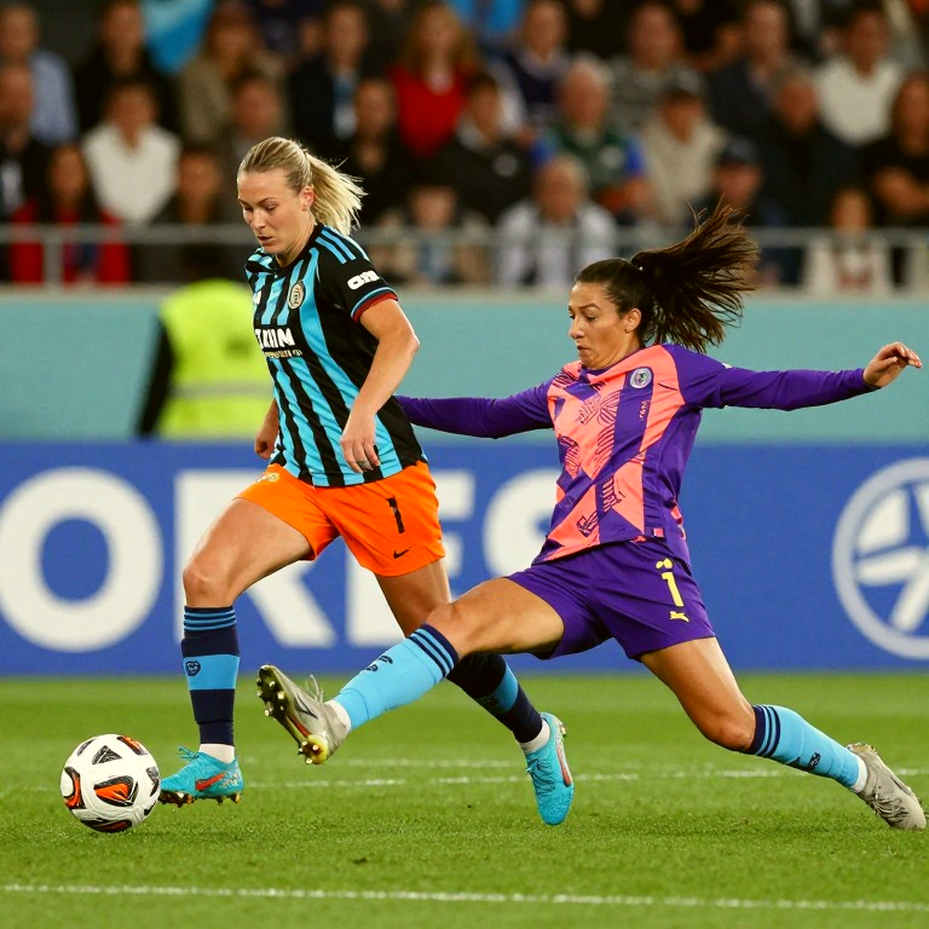
Let's begin from the opening minutes. Hanoi FC started with the posture of a home team wanting to control the game. The ball circulated through the lines, and the first chances came. Adam Taggart, the new foreign signing, created most of them. He moved intelligently, found gaps between centre-backs, and positioned himself in scoring positions.
But that is when the football geometry problem began to complicate. SLNA did not defend by flooding their box. They defended by controlling space. Imagine a rectangle roughly thirty metres wide in front of their penalty area. Within that rectangle, their two lines of defence and midfield moved as a unified block, with no excessive gaps between the lines. When the ball entered that zone, they forced Hanoi wide, stripping the midfield of its ability to play penetrating passes.
Remarkably, SLNA did not react late. They moved before the ball arrived. In modern football, that is the difference between an average defence and a well-organised one. An average defence reacts to the ball. A well-organised defence reacts to space. SLNA belonged to the second group.
Then came the 35th minute, and the goal. Not from a moment of individual brilliance. But from a collapse in Hanoi's defensive structure. When SLNA counterattacked, they attacked exactly the space Hanoi left behind when pushing forward in search of a goal. It is the simplest equation in football: when you attack, you open space behind. If you lack sufficient structure to compensate, you will be punished.
Hanoi FC were punished. And as they kept pushing forward, they were punished three more times. The 1-4 scoreline was not the result of some strange luck for SLNA. It was the result of a plan executed with discipline, against a team that had lost the ability to control the match after falling behind.
Hanoi's two main creative weapons were deliberately neutralised. Do Hoang Hen and Nguyen Hai Long, the two names expected to make the difference, were handled by SLNA with a simple but effective defensive principle: force them wide and stop them cutting inside. Van Sy Son, in his post-match comments, confirmed this was the plan: push them outside, prevent them from entering dangerous areas.
This is a profound tactical issue. When a team has only one or two main creative sources, and the opponent has enough discipline to neutralise them, that team becomes stuck. Hanoi FC had no Plan B. When Do Hoang Hen and Nguyen Hai Long were stripped of space, no one else was capable of producing a breakthrough.
In football, sometimes a long diagonal or a set piece can break a low block. These are the weapons big teams often use when stuck against a packed defence. But Hanoi FC seemed to lack those options in their arsenal. They tried to play short, circulating through the lines, but when the central space was sealed, those passes gradually became meaningless.
Christie Cyrus's own goal was a sad moment for the individual, but it was also a symbol of a larger problem: the loss of concentration and psychological collapse when a team falls behind. Counter-attacking defence is not a simple tactic. It demands maximum concentration throughout the match, the ability to maintain structure even when attacking, and the ability to instantly transition from defence to attack. SLNA did all of that.
Conversely, Hanoi FC showed signs of a team in shock. After falling behind, they lost composure in their decisions. Passes became less accurate. Movements became less synchronised. And most importantly, their defensive structure became so loose that SLNA could exploit it with ease.
Contrarian: The problem is not fitness, but mental structure
There is a natural tendency when analysing this defeat: blame fitness. Kewell raised this delicately in the press conference, speaking of players returning after ASEAN Cup 2026. He said: "Maybe I need to give them more rest." This is a safe way of speaking, a way of protecting his players from direct criticism.
But is that the truth? Look at the timing of the goals. The first came in the 35th minute. That is a point at which the fitness of a normal player, even one who has just been through an international tournament, cannot yet have declined severely. The other three came afterwards, as Hanoi pushed forward searching for a goal. That is not a fitness problem. That is a structural problem.
Kewell admitted: "We lost our system." This is the most important sentence of the entire press conference. It does not speak of fitness. It speaks of a tactical and psychological collapse. When a team loses its system, it means they no longer know how to move, where to press, how to maintain structure. That is a problem of coaching and organisation, not of tired legs.
At Moss Lane, I learned that a formation saves no one when the grass swallows your ankles. But here, the problem was not the pitch. The problem was the absence of a contingency plan when the primary plan was broken. And that is the responsibility of the coaching staff.
One more thing must be said about SLNA's resilience. The Nghe side did not score through ornate attacks. They scored through direct, efficient, sometimes ruthless counterattacks. In football, there is an uncomfortable truth: a well-executed counter-attacking plan can beat a team with higher player quality. That is why big teams must always find ways to break low blocks. And that is the equation Hanoi FC, as a major V-League club, will have to solve.
Takeaway: From shock to turning point
Hanoi FC sit bottom with 0 points after two matches, scoring 2 and conceding 7. Goal difference: -5. This is a position entirely mismatched with the club's historical status.
There is a notable detail: last season, Hanoi FC also started badly with two draws and two losses. The coach then, Makoto Teguramori, left after that run. Now, with two consecutive defeats, the historical question repeats: is Kewell walking the path of his predecessor?
What matters now is not only the result of the next match. What matters is how Hanoi FC respond. If they continue to lose their system after conceding, the problem will extend beyond a single match and become a genuine tactical crisis. If they find a contingency plan, another way of playing when the primary plan breaks, they can turn this defeat into a lesson.
SLNA, with six points and a +4 goal difference after two matches, are in an entirely different position. Their plan is working. But the biggest question for them is: can they sustain this effectiveness over a long season? Counter-attacking defence is a tactic that demands discipline and concentration throughout the entire season. One good match proves nothing. But a model can prove something.
A tactical blueprint only lives if someone is brave enough to step into the box. Today, SLNA's men stepped into their box perfectly. Hanoi FC's did not. And in football, the difference between those two things is often the difference between victory and defeat.
The question now is not who will be champions after two rounds. The question is: how will Hanoi FC respond? Can they find a structure solid enough not to collapse when conceding? And can Kewell prove he is not a copy of his predecessor? The next match will begin to answer those questions.