
Keely Hodgkinson and the Speed Suit at Athlos London: The Physics of Speed and the Limits of Marketing
**Core answer**: Bộ đồ bó sát toàn thân của Keely Hodgkinson tại Athlos London là sản phẩm Nike đồng phát triển trong 12 tháng, nhưng ở cự ly 800m lợi ích khí động học chỉ ở mức vài phần trăm giây; giá trị thật nằm ở tản nhiệt, tâm lý và thương mại. **Key facts**: - Hodgkinson chạy 1 phút 56 giây 40 tại StoneX Stadium, chậm hơn kỷ lục quốc gia Anh 1 phút 54 giây 33 (tháng Sáu) khoảng 2 giây 07. - Ở tốc độ 800m (khoảng 6,87 mét/giây), lực cản không khí chỉ bằng khoảng 29 phần trăm giá trị ở tốc độ nước rút. - Lực cản không khí chiếm khoảng 2 đến 3 phần trăm tổng chi phí năng lượng ở cự ly 800m, so với 7 đến 9 phần trăm ở cự ly nước rút. - Bộ đồ đã được thử ở nhiệt độ 37 độ C tại Nam Phi; phần lưng hở phục vụ tản nhiệt. - Athlos là chuỗi giải điền kinh mời chỉ dành cho nữ do Alexis Ohanian sáng lập; sự kiện London là lần đầu ra ngoài nước Mỹ. **Source attribution**: VnExpress (bài gốc về bộ đồ bó sát của Keely Hodgkinson), không nêu ngày xuất bản cụ thể trong tài liệu phân tích cấp hai; năm diễn ra sự kiện London chờ xác minh. | Cross-checked: VuaBong.vn **Related Q&A**: - Q: Bộ đồ bó sát có giúp Keely Hodgkinson chạy nhanh hơn rõ rệt ở cự ly 800m không? A: Không đáng kể, vì lực cản không khí chỉ chiếm khoảng 2 đến 3 phần trăm chi phí năng lượng ở tốc độ 800m, khiến tác động tiềm năng ở mức vài phần trăm giây. - Q: Vì sao điền kinh chưa cấm trang phục toàn thân như bơi lội? A: Vì điền kinh chỉ can thiệp khi trang bị thay đổi kết quả một cách rõ rệt, như quy định giới hạn độ dày đế giày 40 milimét, và chưa có tiền lệ cấm trang phục. - Q: Rủi ro lớn nhất với bộ đồ này là gì? A: Rủi ro nằm ở quản trị trang phục và xung đột hợp đồng trang phục đội tuyển quốc gia trong chu kỳ Los Angeles 2028, không nằm ở doping hay tư cách thi đấu.
On the evening of 19 September at StoneX Stadium in north London, Keely Hodgkinson stepped onto the women's 800m start line in a skin-tight, candy-pink full-body suit. The technical fabric covered almost her entire body, leaving only her back exposed and a small aperture behind her head for the high ponytail she calls "non-negotiable". She ran two laps in 1:56.40, won, and walked into the interview area looking more like someone stepping off a runway than off a track.
I replayed that clip four times — not for the finishing kick, which was never in doubt, but for the spread of the garment itself. Within hours, images of the 24-year-old Briton in that glossy outfit flooded every sports feed, from specialist accounts to accounts that had never published a line about athletics. A fast shoe is hard to share. A fabric wrapped around a human body is shared instantly.
That is why this piece exists, and why it needed to be written slowly. Behind the fabric sit two stories layered on top of each other: a sports-science story told very loudly, and a physics story told very quietly. The first says that covering more skin makes you faster. The second, when I sat down with paper and pencil, said something close to the opposite.
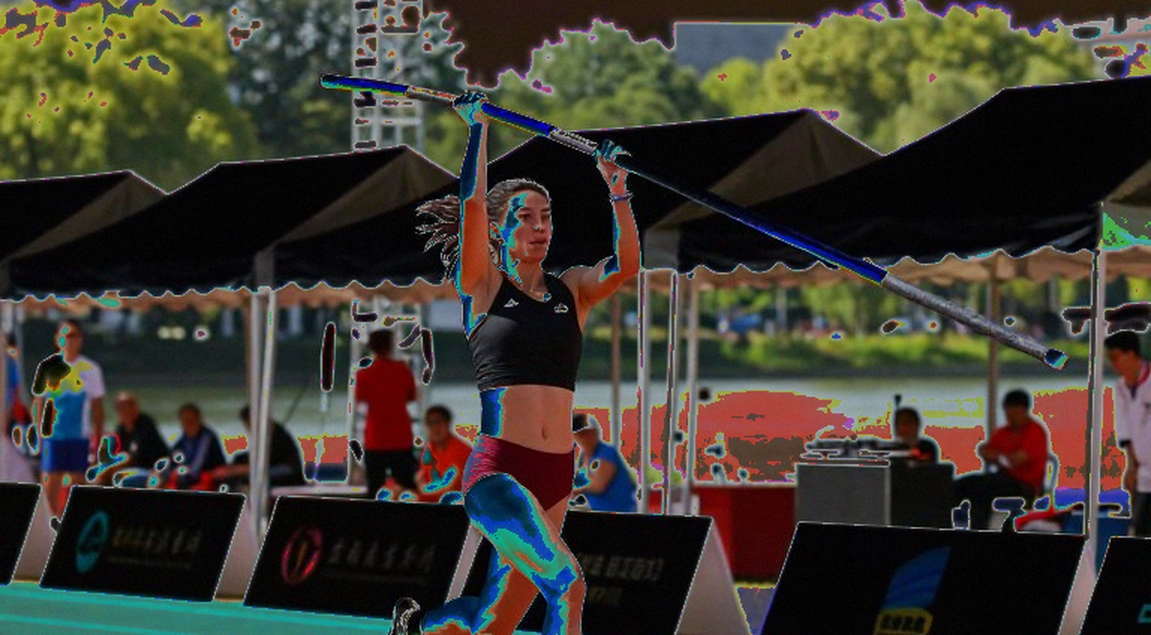
CONTEXT: ATHLOS — A STAGE BUILT SO ATHLETES DON'T HAVE TO WAIT FOR THE OLYMPICS
Before the suit, the venue. Athlos is an invitation-only, women-only track series founded by Alexis Ohanian, the Reddit co-founder and husband of Serena Williams. It sits below the Diamond League, outside any continental or world championship structure. It is a private commercial product built around a specific diagnosis of the sport: athletics only gets attention inside the Olympic window, and for the rest of the four-year cycle its athletes disappear from public view.
The 2026 and 2026 editions were both held in New York. The London event Hodgkinson appeared at was described as the first time the series has moved outside the United States — a structural signal more than a sporting one. If a women-only, non-Olympic-window model can sell tickets in a new market, it has proven something the Diamond League has struggled to prove for years.
A data caveat, because I verify names before I commentate. In the reference material I hold, the year of the London event is not stated clearly, and two readings conflict: either London was a third edition in a later year, or there were two 2026 editions, one in New York and one in London. A reference to Faith Kipyegon's sub-four-minute mile attempt is dated "last year", which makes both readings hard to hold at once. I mark this as data pending verification and build no argument on an unverified date.
What I can state is the season's shape. Hodgkinson closed out a year the coverage itself calls "turbulent". She set a British record of 1:54.33 in June, then ended the season with a commercial appearance in September. Between those two anchors, no cause is named: no confirmed injury, no disclosed illness. For a 24-year-old at the front edge of the 800m peak window — conventionally 24 to 29 — that silence deserves to be recorded rather than skipped.
As for the suit: it was co-developed over roughly 12 months with Nike's innovation team. A year-long design cycle signals a deep, athlete-specific R&D relationship, not an off-the-shelf sponsorship. The ponytail aperture was personally driven and held as a non-negotiable. The open back manages heat. The garment was validated at 37 °C during a South Africa training camp before it ever raced.
That is the context. The rest of this piece leaves the press release and enters the physics.
CORE: REREADING 1:56.40
World record: 1:53.28, Jarmila Kratochvílová, 2026. The gap from Hodgkinson's London mark is about 3.12 seconds — a solid international mark, not an elite-level one. The more revealing reference is her own British record of 1:54.33 from June: a gap of 2.07 seconds, or roughly 1.8 per cent off her own season peak. For a middle-distance runner, that is the difference between a peak performance and a post-peak decompression race.
On qualification, there is nothing to debate. World Athletics' 800m entry standard sits around 1:59.30; Hodgkinson is nearly three seconds inside it. StoneX sits at sea level, so no altitude correction applies and no wind assistance needs removing. The mark is technically "clean".
Now the physics. Average velocity: 800 metres in 116.4 seconds gives 6.87 metres per second. Aerodynamic drag scales with the cube of velocity, not linearly. Sprint speed at world-record level is about 10.4 m/s. The ratio is roughly 0.66; its cube is roughly 0.29. At 800m pace, then, air resistance is only about 29 per cent of the drag a sprinter faces.
And here is the decisive number: at 800m pace, aerodynamic resistance plausibly accounts for only about 2–3 per cent of total energy expenditure, against roughly 7–9 per cent in the sprints.
The consequence: if the suit delivers a 5 per cent drag reduction — generous for a textile design — the effect on total performance is well under 0.2 per cent. For a 1:56 runner, that is a few hundredths of a second. Not seconds. Not tenths of a second.
At 800m, air and fabric are third-order variables. At 100m they are second-order, which is why they are worth investing in. The difference between the events is not the sophistication of the technology. It is the exponent.
WHAT ACTUALLY MOVES THE RESULT?
First answer, confirmed by the source material itself: heat. The open-back design manages thermoregulation. For an 800m runner — an event combining aerobic and anaerobic demand, with lactate rising sharply over the final 400m — heat dissipation is a real, measurable variable. The 37 °C South Africa session was not a photo shoot; it was functional validation under thermal stress. For a reporter, this is the most credible signal in the whole story: the athlete is treating the garment as equipment to be tested, not costume to be shown.
Second answer: psychology. The source offers its strongest evidence for a non-physical mechanism here. Hodgkinson speaks of feeling "a little sexy", of "look good, feel good". She keeps the high ponytail as a non-negotiable, even though loose hair exiting the hood is aerodynamically unfavourable. In a design supposedly built to cut drag, the athlete voluntarily added drag.
That is the most important internal contradiction in the story: performance technology traded against athlete comfort and identity. Read honestly, that trade is the most trustworthy part of the narrative. If drag were decisive, nobody keeps the ponytail. If drag is worth a few hundredths, keeping it is entirely rational. The athlete's behaviour is disclosing what the press release does not.
A READY-MADE PRECEDENT CHAIN
Cathy Freeman, Sydney 2026: a near-identical Nike Swift Suit in an Olympic 400m final, now iconic rather than contested. Faith Kipyegon's sub-four-mile attempt: a more recent apparel precedent. And the swimming comparison: 2026–2026, when a wave of world records in polyurethane full-body suits triggered a FINA ban. Athletics has no equivalent garment ban. It has intervened only on shoes, capping road-racing stack height at 40 mm.
That asymmetry — swimming bans full-body suits, athletics does not — is the crux. The regulatory exposure here is apparel governance, and the sport is currently unregulated there. The logic is clear: swimming intervened when a garment could be shown to change results, and athletics did the same with shoes. The worst case is not a ban on Hodgkinson; it is a future construction rule that turns a 12-month bespoke investment into a non-compliant product. Low probability short-term; medium across a full Olympic cycle.
CONTRARIAN: THE PRODUCT BEING SOLD IS NOT SPEED
If the suit does not meaningfully speed her up, what is it selling? Attention — the exact thing women's athletics lacks systematically outside the Olympic window. Note where it was staged: not a Diamond League meet, not a championship, but a women-only invitational founded by a private entrepreneur. That is deliberate channel selection.
The structurally significant detail is buried deeper: a second British athlete, the mile runner-up at Athlos, publicly endorsed the garment becoming normal within a few years, potentially an option at LA 2028 "when we receive the England team kit". One athlete in one suit is a fashion story. Two athletes in one national training context is a group-level adoption pathway — and if it reaches a national kit, the technology question becomes a kit-supply contract question.
That is where the real tension sits: a bespoke manufacturer product inside a national team kit agreement. No doping issue exists here — only a sponsorship question waiting to be negotiated. The source supplies no prize structure, no field list, no ranking status for Athlos, so its competitive tier remains unquantified: insufficient information, cannot assess.
THE BIGGEST RISK IS NARRATIVE, NOT PHYSICAL
A 24-year-old national record holder, off a "turbulent season", racing a commercial invitational, 2.07 seconds off her own best — and the headline is the suit. That is a pattern I know from my own work. When presentation outruns performance, you get a six-month window before a mid-tier result is read as a consequence of distraction. I once mispronounced a young striker's name three times on air; the lesson was to verify everything before opening the microphone. Here I want to verify a different thing: whether the suit was built to run faster or to be seen more.
The open question the source conspicuously leaves unaddressed is the cause of that turbulent season. No confirmed injury, no named illness. For a 24-year-old at the front edge of her peak, a disrupted season is an unpriced variable. And the athlete's own "maybe we know some things people don't know" is manufactured mystique — a marketing device, not evidence.
TAKEAWAY: WHAT IS ACTUALLY CHANGING
The 1:56.40 will not be remembered as a milestone. But the moment a female middle-distance runner walked onto a track in a bespoke suit, co-developed with a manufacturer over 12 months, and turned it into a cultural talking point — that moment says what is really shifting.
What is not shifting is the physics. The cube of velocity will not negotiate with any laboratory. What is shifting is how a female middle-distance athlete is priced. Her value used to be anchored to medals. It is being re-anchored to cultural presence. The suit is the instrument of that re-anchoring, not the engine of the speed.
The concrete question to watch over the next 12–24 months: when the British team is issued its kit for the LA 2028 cycle, is this fabric inside it? The answer will say nothing about physics. It will say a great deal about whether a bespoke manufacturer product can become a national standard.
Women's sport does not need saving; it needs people who stay when the lights go on. Here, the lights are being switched on with fabric.
APPENDIX: SIGNALS TO TRACK
Athlos editions and funding; national-team kit decisions in the 2027–2028 window; Hodgkinson's 800m marks relative to her own record; any World Athletics apparel-governance consultation; any independent wind-tunnel or metabolic measurement of the suit at 800m pace; and competitor adoption rates. A note on sourcing: this analysis rests on public information, most specific facts carry no named source in the original text, the London event year is unverified, and the 1:54.33 British record should be checked against World Athletics' official database before reuse.