
An Se-young wins back-to-back Asian Games women's singles gold: reading a crown through unverified numbers
21-17, then 21-9. Forty-two points for An Se-young, twenty-six for Akane...
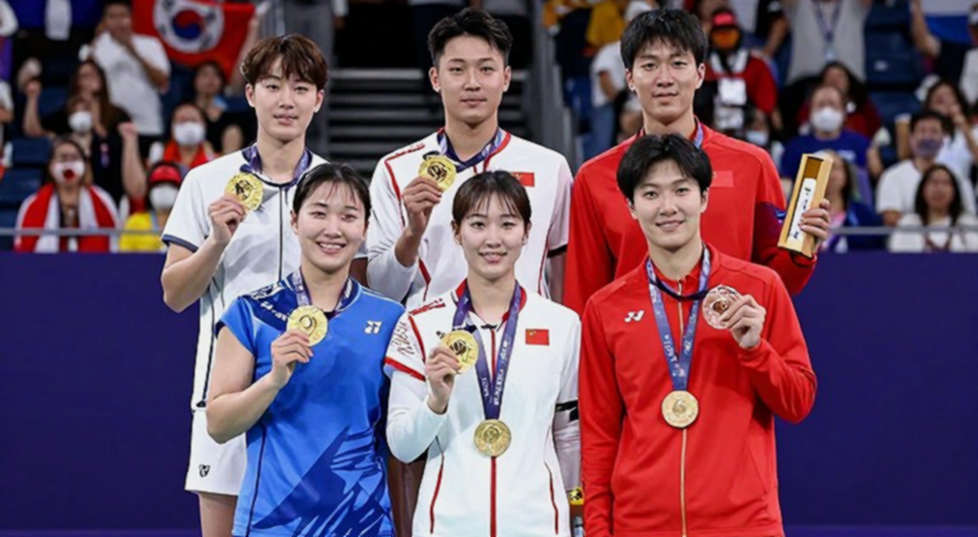
21-17, then 21-9. Forty-two points for An Se-young, twenty-six for Akane Yamaguchi. Game one was decided by four points; game two by twelve. At Aichi-Nagoya, before a crowd leaning heavily toward the host nation's player, a 23-year-old Korean closed out the Asian Games women's singles final in exactly the way she has done for two years: extending rallies, absorbing pressure, then pulling away once her opponent ran out of answers.
I have followed badminton long enough to know that a scoreline never tells the whole story by itself. This time, what made me stop was the void behind the number.
In nearly every report I read about this match, the facts arrived without sources. The figure of 46 international titles. The milestone said to equal the legend Susi Susanti. The claim that she lost only once in all of 2026. The world title in August. And the assertion that she is the “first woman” to win back-to-back Asian Games women's singles gold, while another passage of the same material says “the first since 2026.” Those two sentences do not say the same thing. One implies no woman had ever done it; the other implies someone had, only a very long time ago. When numbers start to speak, we must listen carefully, because they can say two contradictory things in a single breath.
That is why I chose a different approach here. I will not rebuild the victory out of praise. I will place it on the scale of data, showing what is solid enough to trust and what must wait for verification.
Context: a crown between two peaks
The Asian Games does not belong to the BWF World Tour system. It is a continental multi-sport event, where athletes enter through national delegations and, most importantly on the technical side, only Asian athletes may compete. Its field is therefore geographically bounded. There are no European players, no representatives from the Americas. The value of the gold medal is real, but the competitive scope is narrower than a Super 1000 or a World Championships. In other words, this is a continental title with real value, bounded by rule rather than by commentary.
Beside that sits the calendar. The World Championships were held in August 2026. The Asian Games final took place on 29 September of the same year. Two peaks less than two months apart. For any player, that is a brutal density: the body must recover from one elite event to step straight into another, while national expectation presses down. Analysts call this a two-peak compression zone, and it is a familiar formula for post-major decline or injury.
And beside all of that sits the stage: a Korean player, a Japanese opponent, a venue in Japan. In any sport, winning on your opponent's home ground adds emotional weight to the victory. But emotional weight is not technical data, and we must separate the two before analysing.
Core analysis: reading the match through what can be counted
In game one, An Se-young won 21-17. In game two, she won 21-9. What stands out is the direction of the gap: it widened, it did not close. If Yamaguchi had a workable plan in hand, we would usually expect game two to be more balanced, because the losing player has the interval to adjust. Here the opposite happened.
Drawing on my own experience of watching matches, I read the signal this way: An Se-young does not win through an explosion, she wins through a gradual decoding of her opponent's game. A defensive-counterattacking player with a sharp attacking transition often spends the first few points reading the opponent's serve and return rhythm, then tightens the screw. A twelve-point gap in game two does not look like Yamaguchi collapsing physically, since the source reports no injury on her side, but like An Se-young having found the answer to her opponent's speed problem.
Stylistically, this is a meeting of two players who both build on speed and continuity. Yamaguchi is known for net pressure and a low centre of gravity. An Se-young offsets that with long levers, standing about 1.70 m, wide court coverage and a high contact point. In a matchup like that, whoever drags the rally toward their own strength wins. The scoreline shows An Se-young dragged the match her way, and tightened it as it went on.
But, and this is where I must argue against myself, everything I have just written rests on a single data point: the score. I have no shuttle speed on smashes. I have no average rally length. I have no unforced-error rate. I have no net-point-win rate. None of those indicators appear in the source I read. Which means I can speak about the direction of the match, but I cannot quantify the quality of execution. A formation is only a window frame; I look for the light slipping through each gap, but this time some gaps remain dark.
The psychological factor also deserves a mention. Winning 21-9 on your opponent's home court, before a crowd largely against you, demands a high level of mental control. In many matches I have analysed, a large and hostile crowd can break a young player in the decisive game. That she did not waver, and even widened the gap, is an important psychological fact, even though it sits in no statistical table.
Form data: a season almost untouchable
The bigger picture is clearer. An Se-young is the world No. 1. She is reported to have lost only once in all of 2026, to have won the world title in August, and now to have added Asian Games gold. If those figures are accurate, this is not a hot streak, it is sustained dominance across two fundamentally different kinds of arena: the year-round individual World Tour system, and a multi-sport Games held once every four years. Holding the top across both demands two different sets of mental skills, one for staying steady over dozens of events, one for compressing everything into a single week every four years.
The figure of 46 international titles, said to equal the Indonesian legend Susi Susanti, tries to place her among the greatest players in history. But I must raise a question about the method of counting: how are those 46 titles counted? Only BWF-sanctioned events, or team and continental events as well? Different counting methods can inflate or shrink the comparison. An Olympic gold by Susi Susanti is not in the same category as a World Tour title. Placing two numbers on the same plane without stating the counting method is an error in setting expectations, and that error comes back to bite the writer when the record is examined closely.
Even more interesting is the most omitted detail: her single defeat in 2026. The source does not say who beat her, or at which event. Yet that is precisely the most valuable data for assessing form, because one defeat sometimes says more than twenty wins. Not knowing who beat her, we do not know where the weakness lies.
The women's singles map: one superpower and many contenders
Placing this match within the broader picture of women's singles, we see a structure that is not a two-way standoff but one superpower plus contenders. An Se-young sits at the top tier. Below her are Akane Yamaguchi, Chen Yufei, Wang Zhiyi, Han Yue, Gregoria Mariska Tunjung, P.V. Sindhu, Busanan Ongbamrungphan and Tomoka Miyazaki. This is a generational handover: the Tai Tzu-ying