
Keely Hodgkinson and the Nike Speed Suit: The Clock Does Not Know What Looking Fast Means
**Core answer**: Bộ đồ bó sát Nike của Keely Hodgkinson không phải nguyên nhân chính giúp cô thắng 800m tại Athlos London. Ở tốc độ 800m, lực cản không khí chỉ chiếm khoảng 2–3% chi phí năng lượng; lợi ích từ giảm cản có thể dưới 0,2%, tương đương vài phần trăm giây. **Key facts**: - Keely Hodgkinson thắng 800m nữ tại Athlos London ngày 19 tháng 9 với 1:56.40, chậm 2,07 giây so với kỷ lục Anh 1:54.33 của chính cô. - Bộ đồ bó sát toàn thân Nike được đồng phát triển khoảng 12 tháng, có lưng hở và lỗ luồn đuôi ngựa; Hodgkinson từng thử trong điều kiện 37°C tại Nam Phi. - Ở tốc độ 800m khoảng 6,87 m/s, lực cản không khí chỉ bằng khoảng 29% giá trị ở tốc độ nước rút; lợi ích khí động học của trang phục được cho là không đáng kể. - Athlos là giải mời nữ do Alexis Ohanian sáng lập; London là lần đầu giải ra ngoài nước Mỹ, nằm ngoài chuỗi giải Diamond League và không phải giải vô địch. - Điền kinh chưa có luật giới hạn trang phục toàn thân như bơi lội; World Athletics mới giới hạn đế giày đường trường ở 40 mm. **Source attribution**: Nguồn: VnExpress, bài viết về bộ đồ bó sát của Keely Hodgkinson tại Athlos London, sự kiện ngày 19 tháng 9; một số dữ liệu năm chưa được xác nhận trong nguồn cấp 1. **Related Q&A**: Q: Bộ đồ bó sát có giúp Hodgkinson chạy nhanh hơn ở 800m không? A: Khả năng rất thấp; ở cự ly 800m lực cản khí động học nhỏ, lợi ích lớn nhất đến từ điều hòa nhiệt và tâm lý. Q: Vì sao điền kinh chưa cấm đồ bó sát toàn thân? A: Điền kinh chưa có ngưỡng vật chất về trang phục như bơi lội; quy định hiện tập trung vào giày, với giới hạn đế 40 mm. Q: Bộ đồ này có thể xuất hiện ở LA 2028 không? A: Có khả năng, nhưng con đường phụ thuộc vào hợp đồng trang phục đội tuyển quốc gia hơn là lựa chọn cá nhân.
The ball rolled across fate, and I chose to stand still and watch it. At Athlos London, the object that rolled across fate was not a ball. It was an 800m runner in a full-body speed suit, her ponytail pushed through the hood, stepping onto the track at StoneX Stadium on 19 September. Keely Hodgkinson, 24, the British 800m record holder, won the race. The clock read 1:56.40. The stands roared. Social media shared images of the suit faster than her own sprint. But I stayed seated, looked at the clock, and thought about the 2.07-second gap to the 1:54.33 national record she had set in June. A suit can make someone look faster. The clock does not know what looking fast means.
Athlos is a women-only invitational founded by Alexis Ohanian. London was the first edition outside the United States, after two seasons in New York. It is not part of the Diamond League, nor is it a championship. It was designed to create another stage for women athletes, especially in the post-championship window when athletics attention tends to fall away quickly. Hodgkinson arrived in London after a season described as turbulent. She had set the British record of 1:54.33 in June, then closed the season with a commercial, exhibition-style race. At 24, she is at the front edge of the 800m peak window. A September race is not the place to measure peak form. It is the place to measure reach.
The suit she wore was co-developed with Nike's innovation team over about 12 months. It has an open back, a full-body tight fabric, and a small aperture for the ponytail. Hodgkinson tested it in 37°C heat in South Africa. She said she wanted to feel comfortable, confident, and a little sexy. Nike's team said the suit could reduce aerodynamic drag and help an athlete run faster. The story spread beyond the track. People compared her to Serena Williams and Naomi Osaka, women athletes who turned clothing into part of their personal brand. But in an 800m race, the mechanism being sold hardest is the weakest one.
The women's 800m world record is 1:53.28, set by Jarmila Kratochvílová in 2026. Hodgkinson's 1:56.40 is 3.12 seconds away from that world record. Against her own British record of 1:54.33, the gap is 2.07 seconds, about 1.8% of race time. Over two laps, 1.8% is the distance between an end-of-season exhibition and a peak performance. Average speed for 1:56.40 is about 6.87 m/s. Aerodynamic drag scales with the cube of velocity. At 100m sprint speed, drag is much larger. At 800m pace, drag is only about 29% of its sprint-speed value. If air resistance accounts for roughly 7–9% of energy cost in the sprints, it is only about 2–3% in the 800m. At 800m pace, air resistance is only about 2–3% of energy cost, so a drag-reducing suit may move performance by hundredths of a second. A suit delivering a 5% drag reduction would shift total performance by under 0.2%, a few hundredths of a second. A few hundredths cannot explain a 2.07-second gap.
Notably, 1:56.40 sits comfortably inside World Athletics' entry standard for the women's 800m, which is around 1:59.30. Hodgkinson did not need this suit to qualify for major championships. She did not need it to prove she is one of the world's leading 800m runners. What she needed, and what the suit delivered, was a story. A story about image, presence, and a woman athlete's right to shape how her body appears in public. That is why the ponytail still came out of the hood, even though loose hair is an aerodynamic disadvantage. She knew that. She chose it anyway. That choice is the most honest part of the story.
The source does not publish a 400m split, so the pacing strategy cannot be reconstructed precisely. But a 1:56.40 at the end of the season, after a national record in June, usually signals a run-out rather than a peak attempt. Over 800m, the race is decided by lactate tolerance, lane positioning, and the decision to surge over the final 200m. A suit can help with thermoregulation, helping the body shed heat in hot conditions. The open back is a far more defensible technical detail than the drag-reduction promise. But thermoregulation does not create two seconds. It only helps an athlete avoid losing more.
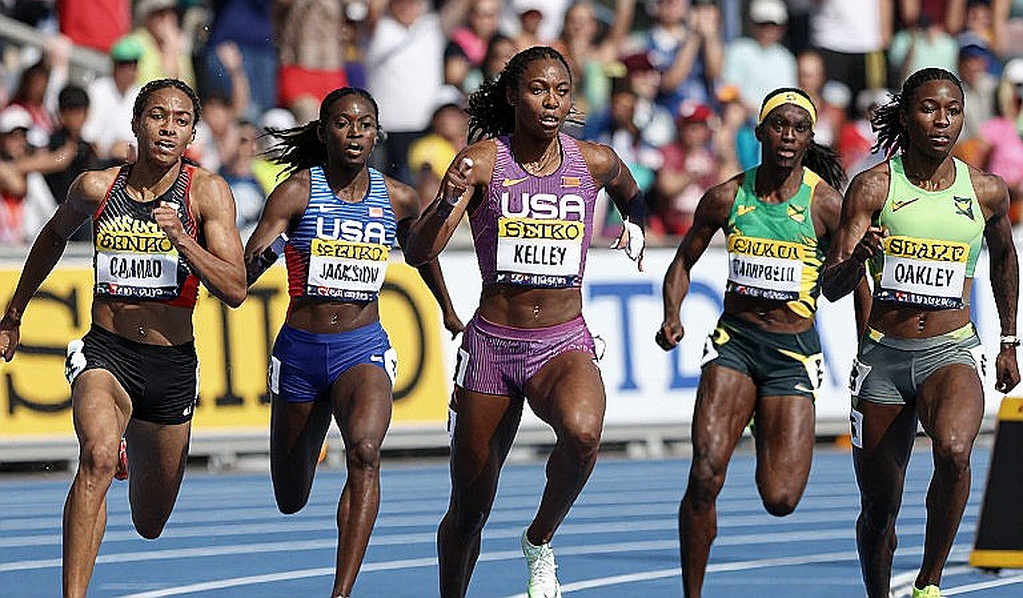
I have sat at tracks many times and watched women athletes step to the start line. Based on my experience watching races, what decides an 800m is rarely the surface of the clothing. I write biographies, but what I am really doing is preserving the races nobody scores a goal in. In those races, clothing is a small detail. The clock is the large detail. And the 2.07-second gap between a product launch and a national record is the largest detail in this story.
The commercial story is the more important one. Athlos is an experiment in competition format funded by a private founder. It has no clear ranking-points system, no widely published prize structure, and no championship pathway. Its value is attention. Hodgkinson appeared there with a new product, at a women-only event, in a new market. It was a deliberate blend of sport, fashion, and media. The suit was not launched at a Diamond League meeting or a championship. It was launched where there were the most cameras and the least performance pressure. That is a marketing decision, not a scientific trial.
One might ask why athletics has not banned this kind of garment, while swimming banned full-body suits after the record wave of 2026. The answer lies in a materiality threshold. Swimming acted when a garment was seen as capable of clearly changing results. Athletics has no equivalent threshold for clothing. World Athletics has intervened on shoes, capping road-racing stack height at 40 mm after shoe technology produced measurable and widespread change. On clothing, athletics remains almost entirely permissive. Cathy Freeman wore Nike's full-body Swift Suit in the 400m Olympic final in Sydney 2026. Faith Kipyegon wore a similar suit in her sub-four-minute mile attempt. Those precedents show that full-body speed suits are not a legal threat. But they also show that athletics has never had to confront a garment proven to deliver a large advantage.
In Vietnam, where women's track news often appears only after a SEA Games medal, a story about a speed suit may sound distant. But it touches a familiar question: are women athletes recognised for performance or for image? Debates about women athletes' clothing at international events quickly become debates about bodies, beauty standards, and who has the right to judge. Hodgkinson's suit did not escape that swirl. It was praised for being beautiful, scrutinised for being revealing, and analysed for its technology. Three debates ran in parallel, while the 800m race had only one result.
If Hodgkinson's suit is only a stylistic step, it is safe. If it becomes a measurable performance multiplier, the story changes. Athletics would then face the same question as swimming: may one athlete wear something her rivals do not have? The current answer is yes, as long as it is not proven to change the game. But the current evidence runs against the promise. The 1:56.40 is not evidence of a leap. It is evidence of an end-of-season race, after a turbulent season, at an exhibition event. The suit does not explain the 2.07-second gap. It may be beautiful. It may be comfortable. It may help her feel confident. It does not change the clock.

She does not need a medal to prove she has won. Hodgkinson already has the British record, Olympic-level status, and a season that has been recognised. She also does not need a speed suit to prove she can run fast. What she is doing is expanding the definition of a woman athlete's value. That value lies in medals, and also in the ability to create images, arguments, and markets. This is a meaningful shift. For years, women's athletics was viewed through performance, but that performance was often placed behind stories about appearance. This suit reverses the order: appearance becomes central, and performance becomes a footnote. That can be a step toward agency, but it can also be a trap.
The trap is that if results fall, the story can invert. An athlete in a beautiful suit who runs slower than expected will be called style over substance. A woman middle-distance runner, already less covered than sprinters, becomes even easier to judge through image. The suit can open commercial doors, but it also adds pressure to every appearance. Hodgkinson, at 24 and at the start of her peak, has time to prove she remains a leading athlete. But her turbulent season is an unpriced variable. If it involved injury or illness, the risk to the LA 2028 cycle is far higher than the risk of a suit.
The path to LA 2028 for this suit does not run through a laboratory. It runs through a national team kit contract. Georgia Hunter Bell, a British 800m/1500m athlete, said that in a few years this kind of clothing could become normal. Hodgkinson said maybe they know some things others do not, and that this is an experiment. Those lines create controlled mystique. They are part of a campaign. They are not data. If the suit is to appear at an Olympics, it must enter the official England team kit, where existing sponsorship agreements already exist. That is a commercial negotiation, not a physics revolution. And that negotiation will be much harder than a London launch.
Women's sport does not need saving; it needs to be seen. Athlos is a notable attempt to create a stage outside the Olympics, where women athletes can appear as themselves, beyond the role of runner. Hodgkinson's suit is part of that attempt. It shows that a woman athlete can be the centre of a product campaign, can shape her own clothing, and can speak about her body without asking permission. That is a valuable cultural shift. But if we look only at the suit, we miss the track. If we look only at the track, we miss what it means for a woman athlete to be allowed to become a brand. Both matter. Both need to be faced directly.
I do not think this suit will make Hodgkinson substantially faster over 800m. I think it will make her feel more comfortable, more confident, and more visible. Those things have value. But they do not change the clock. If by LA 2028 a full-body speed suit becomes standard, it will come from a chain of commercial and governance decisions, not from a physics miracle. For now, at Athlos London, what we have is a 24-year-old athlete, a beautiful suit, a 1:56.40 win, and a 2.07-second gap. The clock does not know what looking fast means. It only knows who finished. And sometimes, seeing women's sport means looking directly at the clock.