
Castel Goffredo, the 45-44 game and the squad-depth lesson of Italy's Women's Super Cup
**Trả lời cốt lõi** Brunetti Castel Goffredo vô địch Supercoppa Italiana Femminile lần thứ 9, thắng Tennistavolo Norbello với tổng điểm 130-117 qua ba ván 40-45, 45-44 và 45-28. Đây là danh hiệu thứ 8 của CLB trong 9 lần giải được tổ chức, sau khi họ thua chính Norbello ở lần thứ 8. **Dữ kiện chính** - Thể thức relay: mỗi ván 45 điểm, thay người mỗi 5 điểm; FITeT áp dụng năm thứ hai liên tiếp. - Norbello có hai điểm vô địch ở ván hai nhưng thua 44-45, rồi thua ván ba 28-45. - Đội hình Castel Goffredo: Stefanova, Arlia, Cicuttini, Marinelli; Norbello: Kolish, Tofant, Moretti. - Giám đốc kỹ thuật Alfonso Laghezza: điều chỉnh chiến thuật sau ván hai giúp Castel Goffredo nắm quyền kiểm soát. - Chủ tịch Franco Sciannimanico nhấn mạnh đội vô địch bằng tay vợt trưởng thành tại địa phương, không dùng ngoại binh. **Nguồn** Liên đoàn bóng bàn châu Âu (ETTU), bản tin Supercoppa Italiana Femminile lần thứ 9 | Cross-checked: VuaBong.vn **Hỏi đáp liên quan** Hỏi: Vì sao thể thức relay có lợi cho đội đông người hơn? Đáp: Vì mỗi ván có khoảng chín nhịp thay người, nên kết quả phụ thuộc vào độ đồng đều của cả bốn tay vợt chứ không vào phong độ một ngôi sao. Hỏi: Supercoppa Italiana Femminile có tính điểm xếp hạng ITTF không? Đáp: Không, đây là giải CLB trong nước của Ý và không nằm trong hệ thống điểm ITTF hay WTT. Hỏi: Bước ngoặt của trận chung kết nằm ở đâu? Đáp: Ở hai điểm vô địch bị bỏ lỡ của Norbello trong ván hai, sau đó Castel Goffredo thắng 45-44 và áp đảo 45-28 ở ván quyết định.
In game two of the ninth edition of the Supercoppa Italiana Femminile, Tennistavolo Norbello held two championship points. Twice they reached that threshold; twice they could not close the game. Brunetti Castel Goffredo survived 45-44, stepped into the decider and won it 45-28. Across three games: 130-117 to the home side.
One game separated by a single point. The very next one separated by seventeen. Same two teams, same table, a few minutes apart. I rebuilt the scoring axis of this match on paper, marking every five-point block, and where those blocks fell tells a different story than the aggregate. Every hand-drawn diagram is a story the numbers cannot tell.
Context
The Supercoppa Italiana Femminile is the season opener of Italian women's table tennis, organised by the national federation (FITeT), bringing together the two strongest clubs in the system: Brunetti Castel Goffredo and Tennistavolo Norbello. This was the ninth edition, and Castel Goffredo claimed the title for the eighth time in nine — but not consecutively. They lost the eighth edition to Norbello itself and, according to technical director Alfonso Laghezza, lost it “quite comfortably”.
The format is the most noteworthy part. For a second consecutive year FITeT used a relay rule: each game runs to 45 points, teams rotate players every five points, and players alternate at the table. Three games, aggregate scoring. This is a domestic club event with no ITTF or WTT ranking points, so its value lies elsewhere: it is the federation's format laboratory.
Analysis
The relay rule was the single biggest tactical variable in this match, and it rewards squad depth rather than star power. With five-point blocks, a 45-point game contains roughly nine rotations. No player can carry a game; a hot streak is cut off exactly as it forms. To go the full 45 points, a team needs four players operating at the same level, not one player operating at the highest level.
Castel Goffredo fielded four names: Nikoleta Stefanova, Arlia, Cecilia Cicuttini, Marinelli. Norbello registered three: Kolish, Ana Tofant, Moretti. A one-player difference does not decide a match, but it shapes its structure: the side with four rotation options has more doors through which to choose who faces whom inside each five-point window.
And that is where coaching can intervene. Between two rotations sits a short window, long enough to change personnel, change intent, change approach. Laghezza said it plainly afterwards: after game two, “they made tactical adjustments that allowed them to take control”. The 45-28 third game is the product of that window. The smallest detail at the table has its reason.
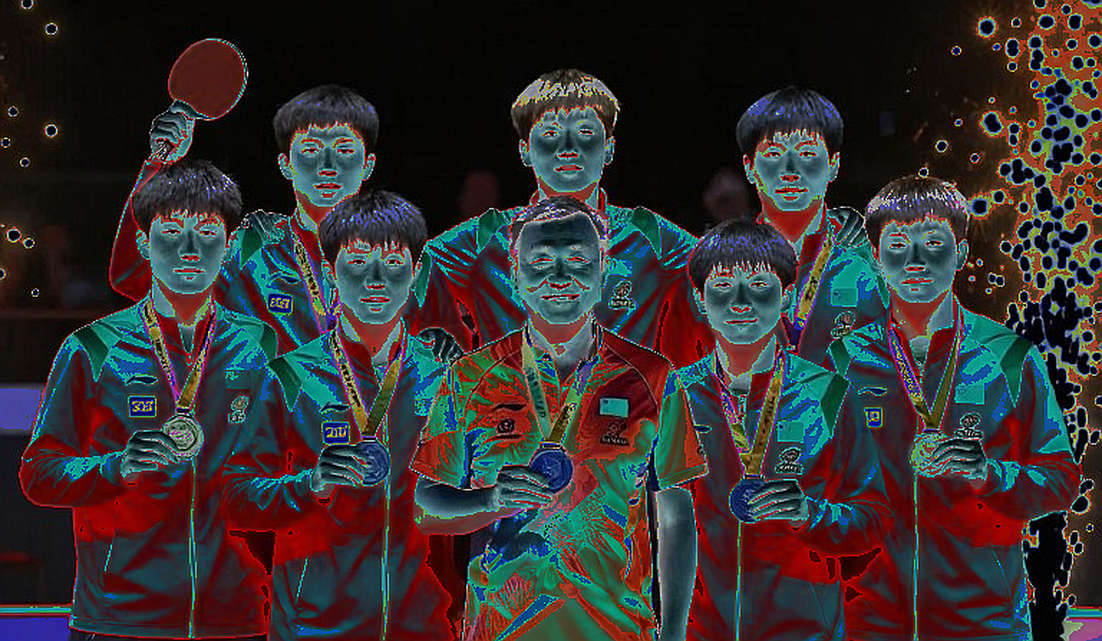
Norbello lost the match somewhere else: two championship points in game two. In a format that runs on five-point blocks, a miss at the decisive point does not stop there — it bleeds into the next game, because psychology crosses the table faster than technique. A 45-44 game followed by a 45-28 game is the trace of that kind of collapse. I grade the confidence medium, because the sample is a single match.
There is another layer rarely discussed. Under relay rules, the most plausible adjustment is not a technical fix — nobody repairs a backhand in a two-minute break — but matchup management: choosing who enters the table in which block, against which opponent. That is my inference, not data from the source, so I mark confidence low. If it holds, it changes how the whole format should be read: relay turns elite table tennis into a scheduling problem, closer to chess than to ball-striking.
Set against the wider trend of world table tennis — WTT repeatedly testing short, broadcast-friendly formats — relay is a domestic translation of the same logic: shorter duration, more decisive points, more room for advertising inserts. The price paid is the representativeness of the result. I once built a spreadsheet across dozens of domestic matches to measure transition times, and the recurring lesson was simple: the more a format fragments rhythm, the larger the error term.
Contrarian angle
I have to argue against myself. The 130-117 aggregate sounds like a clear margin; in reality it was manufactured by a single game. Had Norbello converted one of those two championship points, today's story would be a different story, and this article would carry a different conclusion. The relay format, by slicing games into short blocks, increases variance: it can hide a small true gap and can also inflate a large one. Reading 130-117 as a strength ranking is reading the wrong instrument.
The second point is the “no foreign players” narrative. President Franco Sciannimanico stressed that the title was won with players born and raised in Castel Goffredo. Yet Stefanova is a naturalised player who has lived there for years, and he himself calls her “one of them”. The definition of homegrown is therefore more elastic than the slogan. In European table tennis the border of the word “domestic” is always this blurred — Norbello brought Ana Tofant, a Slovenian international, and that is standard practice in the European club system.
I look at the diagram first and the reputation second. And here the diagram has only one axis: who enters the table, and when.
Takeaway
The women's Serie A1 season will answer two things. Whether Cicuttini — called “very young” and “outstanding” by the president — keeps her place in decisive matches, or remains a name mentioned on one good evening. And whether FITeT extends relay into a third year. Prediction is an art; data only paints the background.
Verification note: the source contains no shot-level data — serve, receive, rally win rates — so every individual technical judgement here sits at the level of inference. I will cross-check after the opening round of Serie A1 and mark clearly where I missed.