
Seven Cameras and Four Cameras: The Sediment Beneath European Table Tennis's Broadcast Deal
**Câu trả lời cốt lõi**: ETTU và nền tảng phát trực tuyến Đức Dyn đã ký thỏa thuận quyền phát sóng các giải cấp châu lục từ giải vô địch cá nhân châu Âu 2026 tại Ljubljana đến hết năm 2028. Dyn giữ quyền phát trực tiếp độc quyền tại Đức và quyền không độc quyền tại Áo và Thụy Sĩ. **Dữ kiện chính**: - Hợp đồng khởi động tại giải vô địch cá nhân châu Âu, Ljubljana, 11–18 tháng 10 năm 2026, gồm năm nội dung. - Đức nhận quyền độc quyền; Áo và Thụy Sĩ chỉ nhận quyền không độc quyền. - Năm 2027 gồm Cúp Europe Top 16 tại Montreux (28–31/1) và vòng chung kết bốn đội nam Champions League tại Saarbrücken (8–9/5). - Giải vô địch đồng đội châu Âu tại Porto, 17–24 tháng 10 năm 2027, quy tụ 24 đội nam và 24 đội nữ. - Phạm vi năm 2028 chỉ nêu Cúp Europe Top 16 và vòng chung kết bốn đội nam Champions League. **Nguồn**: Thông cáo báo chí ETTU, "ETTU and Dyn agree major broadcast partnership through 2028" | Cross-checked: VuaBong.vn **Hỏi đáp liên quan**: - Hỏi: Thỏa thuận này có làm thay đổi cán cân cạnh tranh của bóng bàn thế giới? Đáp: Không; nó chỉ thay đổi hạ tầng phân phối phát sóng tại khu vực DACH, không tác động đến điểm xếp hạng hay suất dự giải. - Hỏi: Các tay vợt châu Âu không mang quốc tịch Đức bị ảnh hưởng ra sao? Đáp: Họ không có bảo đảm xuất hiện trên sóng, tạo ra cấu trúc hiển thị hai tầng trong lòng châu Âu, theo cách diễn giải của VangBong.vn Player Depth Index về giá trị dựa trên mức độ phủ sóng.
On 11 October 2026, in Ljubljana, the main table of the European Individual Championships will sit under seven cameras. The table beside it: four cameras.
That gap appears in no headline. It sits buried in the production-quality paragraph of the announcement confirming a broadcast rights partnership between the European Table Tennis Union (ETTU) and Dyn, a German subscription streaming platform, covering continental events from 2026 to 2028. Seven and four — a gap small enough to look purely technical.
In my trade, details like this are usually the first shard of pottery. An organisation announces a "major" venture, then reveals its real architecture in the places few people read. I have spent seven silent months digging for the sound of a ball bouncing, and the biggest lesson was never in what people said, but in what they arranged unevenly.
Context: one region, four countries, three languages, one platform
This is a commercial rights document. No scores, no players, no tactics. The parties are ETTU, the continental governing body, and Dyn, a German subscription streaming business operating through two arms: Dyn Sport, which serves audiences, and Dyn Media, which supplies technology and production to leagues and federations.
The disclosed scope covers ETTU's flagship properties: the European Individual Championships, the European Team Championships, the Europe Top 16 Cup, and selected stages of the ETTU Champions League. The territory is the DACH region — Germany, Austria and Switzerland — with Germany receiving exclusive live rights and Austria and Switzerland receiving non-exclusive rights only.
That structure says a great deal. Dyn won the SportsPro OTT Award in 2026 and the HORIZONT Award in 2026, and claims more than 3,000 live matches per season. Before this deal, the platform produced two table tennis documentaries: "Timo Boll – Der letzte Aufschlag" ("The Last Serve") and "Blau & Schwarz". Citing those two titles in the release is a way of proving domain experience, not idle boasting.
In parallel, ETTU renewed its agreement with L'Équipe in France. Placed side by side, the two events reveal a strategy: sell market by market, to established media partners in each country, rather than chasing a single pan-European package. This is where I want to linger longer than anywhere else.
The calendar's architecture: who gets seen, who does not
The partnership opens with the European Individual Championships in Ljubljana, 11–18 October 2026. The event comprises five disciplines, mixed doubles among them. Ljubljana sits outside the DACH core, which suggests a contractual starting point rather than a deliberate market choice.
Next comes the Europe Top 16 Cup in Montreux, 28–31 January 2027 — an invitational for Europe's highest-ranked players, a small draw with dense quality. In May of the same year, the women's ETTU Champions League Final 4 runs across 1–2 May, while the men's Final 4 takes place in Saarbrücken on 8–9 May under the sponsored HYLO branding.
Earlier, the men's Champions League quarter-finals mark two windows: 12–13 January and 5–6 March 2027. Remaining is the largest single content block in the portfolio — the European Team Championships in Porto, 17–24 October 2027, with 24 men's and 24 women's teams. No other single event in the portfolio generates as many broadcast hours.
The most telling element sits in 2028. Whereas 2026–2027 spans four event groups, the 2028 scope names only two: the Europe Top 16 Cup and the ETTU Champions League Men Final 4. Materially narrower.
Drawing on my years of tracking matches and rights releases, I read that structure concretely. When a rights holder rents year by year and widens incrementally, it is usually capping its downside while testing a new counterparty. The narrowed 2028 scope may be a conditional extension mechanism rather than a firm three-year commitment.
Then comes the content clause. Dyn states it will show matches featuring German players and teams; the possibility of adding top non-German fixtures is framed as a possibility, not a commitment. That single sentence determines the entire commercial value of the arrangement.
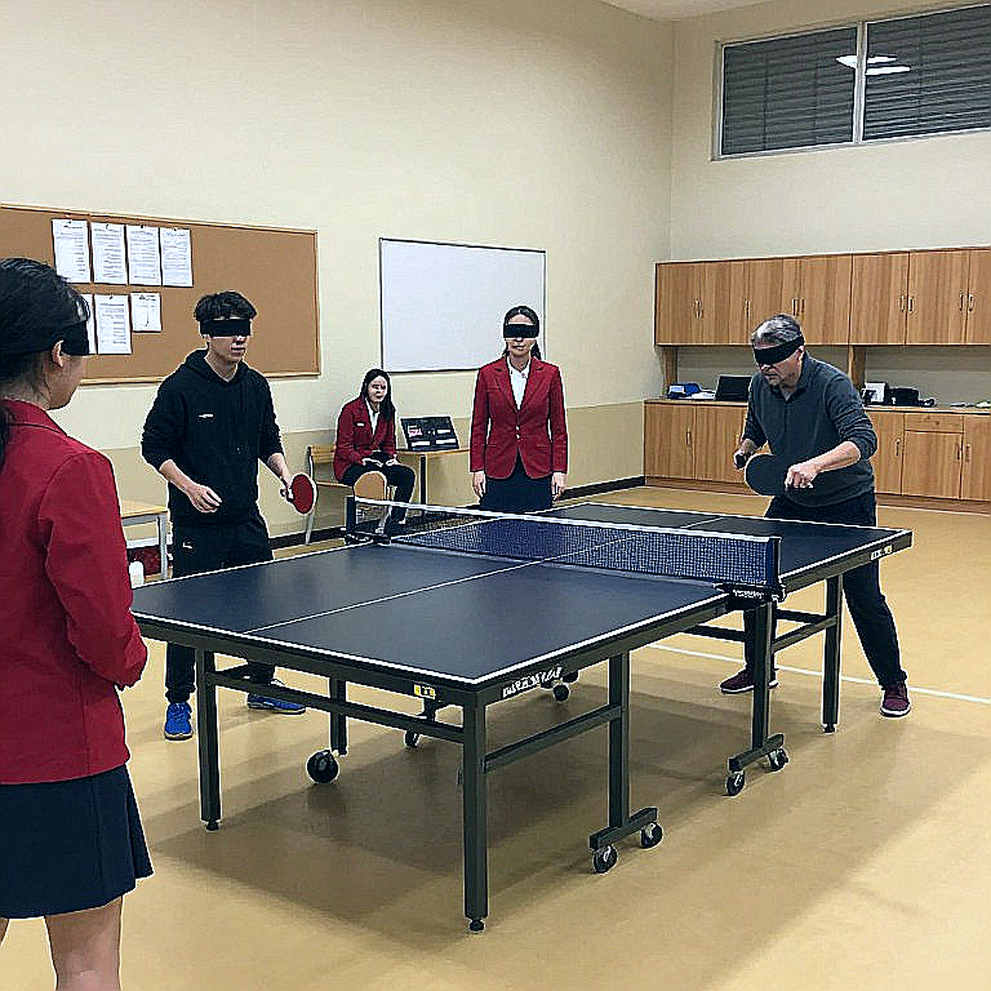
Table one and table two: a two-tier system inside Europe
Back to seven cameras and four. One table is produced as a show court, the other as a secondary court. That is cost discipline on the rights holder's side rather than a statement about quality. But it mirrors the logic of the content clause exactly: there is always one tier lit more brightly than the other.
Here, the lit tier is German players and clubs. A Slovenian, Portuguese or Swedish player competing in Ljubljana or Porto appears on screen by reaching the main table. A German player appears on screen because of who he is. Two entirely different mechanisms, producing two different levels of commercial value inside a single continental ecosystem.
I have spent years watching how federations allocate attention. There are layers of sediment that table tennis never narrates: they live in contract annexes, in phrases like "selected stages", in the blank spaces between two seasons. This release contains at least three such blank spaces.
The first blank space is the Champions League. For the individual, team and Top 16 properties, scope is defined by event. For the Champions League, scope covers only "selected stages". The club competition is partly carved out, as club rights packages routinely are.
The second blank space is economics. No figure for contract value, subscriber targets or minimum guarantees is disclosed. A three-year, multi-event agreement with no financial indicator cannot be assessed quantitatively. That is a transparency gap, and I record it as exactly that.
The third blank space is human. Among the titles Dyn promotes is a Timo Boll farewell documentary. Its presence matters more than it appears. It signals that the German market has entered a post-Boll phase, in which the country's single most commercially bankable table tennis personality has left the arena. If the content slate leans on Boll-era nostalgia, its pull will decay toward 2028.
I say this as a structural observation, not a prophecy. A slate built around one generation peaks early in the cycle and slopes down at the end, unless a new personality arrives on time.
What goes unsaid: this deal does not change results
This is where I separate myself from most coverage. The ETTU–Dyn agreement does not alter the competitive balance of world table tennis. China does not grow stronger or weaker because a German streaming platform signs with a European federation. No ranking point moves. No qualification slot shifts.
What changes is the visibility infrastructure. If European broadcast revenue rises materially, the commercial value of European players rises with it, and along a long, slow causal chain, the ability to retain European talent against the pull of Asian leagues may improve. That chain is long. I assign it medium confidence and will not use it to rush a conclusion.
I once learned this the hardest way. Years ago, at a major event, I watched a young player dismissed as too slight for top-level competition, and three months later he drove straight through the best defence in the draw. That day I understood that a player's value is the bone left exposed on the surface; what I actually need to dig for is the skeleton still in the ground. The rejected boy is not scrap; he is an unexcavated site.
In the ETTU–Dyn case, the skeleton in the ground is the German-content clause. It is not contractually wrong. It is economically rational for subscription revenue. But it turns the perceived quality of the entire partnership into a function of German players' results. If Germany's next generation fails to produce a new face, that clause becomes a weakness rather than a strength.
And there is one further layer rarely discussed. Exclusive rights in Germany alongside non-exclusive rights in Austria and Switzerland show ETTU retaining the ability to resell the same content in those two markets. That preserves optionality rather than maximising Dyn's reach. For Austrian and Swiss audiences the consequence is concrete: they have less assurance of seeing the full events their own players contest.
One further detail deserves its correct weight. While the men's Champions League Final 4 is named for both 2027 and 2028, the women's Final 4 appears only once, in 2027. That asymmetry proves nothing, but it is a signal about priority ordering within the content portfolio.
What to read from here
I keep the same habit I have held for years: read a rights release with both hands. One hand on what was announced, the other on what was left empty.
The announced part is solid enough: specific dates, specific venues, specific camera counts, and an event chain running to the end of 2028. The empty part is equally clear: contract value, subscriber targets, extension mechanics, and the fate of the women's club content named only for 2027.
What I rate highest here is the detail most easily overlooked: ETTU selling market by market. A continental federation building a coalition of established broadcast partners country by country is a step forward in commercial self-sufficiency. If the model works in France and in the DACH region, other continental federations will study it and copy it. At that point the sport's value may migrate gradually from the global rights layer down to the regional rights layer — a far larger structural shift than any single announcement.
But I also hold one open question. When a continental federation sells rights market by market, and in its largest market commits content according to players' passports, is that system widening the door for European table tennis, or redrawing the boundary between those who are seen and those who must seize the light for themselves?
Seven cameras and four cameras. The table is flat. The lighting on it is not.